Heat Trace Products
One manufacturer, every environment. FloTrace self-regulating heat trace cable covers standard freeze protection, chemical and corrosive exposure, and Class I Division 2 hazardous locations. UL Listed. You'll find the right cable here. Starting at $3.25/ft.
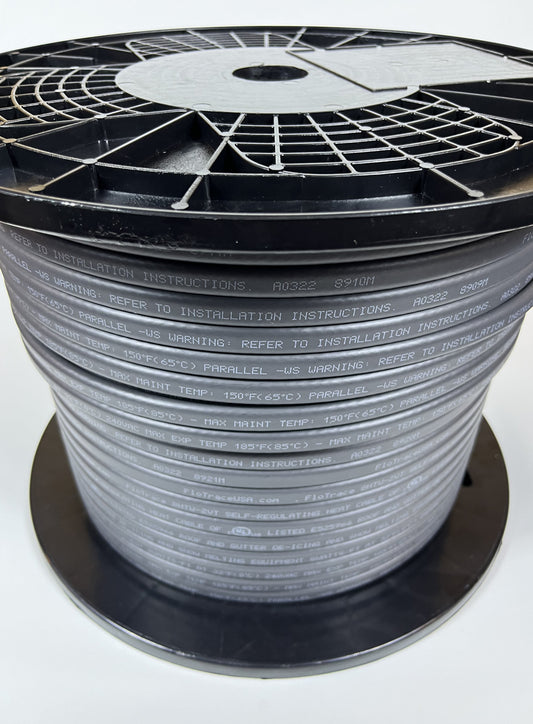
Standard Polyolefin Jacket Cable
If you're keeping pipes from freezing, clearing ice off a roof, or maintaining process temps in a commercial or industrial setting, this is your cable. Available in 5W, 8W, and 10W on 500 ft. and 1,000 ft* bulk spools. (*1,000 ft available in 5W and 8W only)
-
Polyolefin Jacket - Self-Regulating Heat Trace Cable | 5 WATTS | 120v or 208v,240v,277v
Regular price From $1,625.00Regular priceUnit price per -
Polyolefin Jacket - Self-Regulating Heat Trace Cable | 8 WATTS | 120v or 208v,240v,277v
Regular price From $1,625.00Regular priceUnit price per -
Polyolefin Jacket - Self-Regulating Heat Trace Cable | 10 WATTS | 500ft. 208v,240v,277v
Regular price $1,625.00Regular priceUnit price per



Wattage Selection Guide
Choose the right wattage for your heat trace application. Our self-regulating cable is available in three standard options to meet different heating requirements and environmental conditions.
| WATTAGE | BEST FOR | TYPICAL APPLICATIONS |
|---|---|---|
| 5W | Light duty, well-insulated runs | Gutters and downspouts, insulated residential pipe, moderate climates |
| 8W | Most commercial and residential jobs | Roof de-icing, pipe freeze protection, commercial buildings, light industrial |
| 10W | High heat load, exposed runs | Uninsulated roof assemblies, extreme cold climates, commercial flat roofs |
Fluoropolymer Jacket Cable
While standard polyolefin is suitable for all general applications, environments involving chemical exposure, extreme temperatures, oils, or solvents require a more resilient outer jacket. Our fluoropolymer cable is specifically engineered to withstand these rigorous conditions that exceed the capabilities of standard alternatives. These cables maintain consistent self-regulating performance and are fully rated for the specific demands of your industrial operating environment.
-
Fluoropolymer Jacket - Self-Regulating Heat Trace Cable | 5 Watt | 500 ft.
Regular price $2,425.00Regular priceUnit price per -
Fluoropolymer Jacket - Self-Regulating Heat Trace Cable | 8 Watt | 500 ft.
Regular price $2,425.00Regular priceUnit price per
Polyolefin or Fluoropolymer?
Selecting the appropriate jacket material is determined by the specific environmental challenges the cable will encounter.
| JACKET | USE IT WHEN | AVOID IT WHEN |
|---|---|---|
| Polyolefin | Most commercial and industrial jobs, like roof, gutter, pipe, standard indoor industrial runs | There's direct chemical exposure, salt spray, or a classified hazardous location involved |
| Fluoropolymer Hazardous Location / Corrosive | Coastal properties, chemical plants, refineries, de-icer exposure, aggressive industrial environments | You're doing standard freeze protection and polyolefin is enough. No reason to pay more. |
Hazardous Location Heat Trace Cable
In a classified hazardous location, the cable has to be rated for it. FloTrace hazardous location cable is cULus listed for Class I, Division 2 environments where flammable gases, vapors, or liquids are present. Built for refineries, chemical processing, oil & gas facilities, and industrial plants where getting the rating wrong isn't an option.
-
Fluoropolymer Jacket - Self-Regulating Heat Trace Cable | 5 Watt | 500 ft.
Regular price $2,425.00Regular priceUnit price per -
Fluoropolymer Jacket - Self-Regulating Heat Trace Cable | 8 Watt | 500 ft.
Regular price $2,425.00Regular priceUnit price per -
Hazardous Location - Self-Regulating Heat Trace Cable | 5 Watt | 500 ft.
Regular price $2,825.00Regular priceUnit price per -
Hazardous Location - Self-Regulating Heat Trace Cable | 8 Watt | 500 ft.
Regular price $2,825.00Regular priceUnit price per
Why Hazardous Location Cable
Not every heat trace cable is rated for every environment. In a classified hazardous location, using a standard cable isn't just the wrong call — it's a code violation. Hazardous location cable is purpose-built and FM Certification & ULus listed for Class I, Division 2 environments where ignition risk is real. If the location is classified, the cable has to match. There's no workaround.
Accessories & Components
Cable alone doesn't make a complete system. You need termination components on every circuit, the right mounting hardware for your installation type, and a controller if you're running a larger commercial job. Everything ships from the same order.
-
2 Circuit Thermostat Controller
Regular price $1,520.00Regular priceUnit price per -
Heat Trace Hard Wired Power Connection Kit - UL Listed
Regular price $39.00Regular priceUnit price per -
Heat Cable End Seal Kit
Regular price $5.90Regular priceUnit price per


WHY CHOOSE FLOTRACE?
Professional-Grade Cable at the Industry's Lowest Price
FloTrace sells direct. The big brands sell through distributors who add their margin on top. We cut that out, so you get the same UL Listed, CSA Approved, FM certified cable at a price that actually makes sense for your business.
-

Starting at only $3.25/Foot
You don't just get a high-quality product; you get it at one of the lowest prices in the industry.
-

Free Shipping
Same-day shipping when you place an order before 12 PM EST, Monday-Friday. Orders over $1,000 ship free.
-

10 Year Warranty
FloTrace heat trace cables are backed by a 10-year manufacturer warranty for long-term confidence and reliability.
-

UL Listed
More Than 30 Years of Heat-Trace Industry Experience.
Heat Trace Product FAQ
What is HeatTrace?
Heat trace is a system used to heat and/or maintain the temperature of equipment.
You will find heat tracing used on pipes, tanks, agricultural equipment, roofs, gutters, and more. Self-regulating heat trace and constant-wattage heat trace are the two common types. Self-regulating fluctuates in temperate based on the surrounding temperature and the other providing constant heat.
Heat trace cable keeps fluid moving, prevents freezing, reduce condensation, and can generally improve the safety and compliance of equipment by way of helping to maintain equipment operations.
How Does Heat Trace Work?
The components of heat tracing are a heating element (the wiring), a conductive core, shielding, thermal insulation, outer jacket, and the various operational components like a thermostat and control panel.
The electricity flowing through the cable increases its temperature.
Self-regulating trace heating cable’s temperature ranges and is ideal for most applications where one needs greater control and precision. Constant-wattage heat trace cables outputs a higher temperature and is ideal when output needs to be consistent. Insulation wrapping the cabling houses and helps retain the heat; an additional weatherproofing layer may be added.
A heat trace system will often be paired with a thermostat or some form of sensors to regulate and monitor temperature. A control system may be added to automatically or manually adjust trace heating when they meet a threshold.
What’s the Difference Between Heat Trace and Heat Tape?
Heat trace and heat tape are somewhat of the same but also different.
- Heat trace, such as what you find on FloTrace, is more like a cable which has some bend and flexibility but is still rigid
- Heat tape is more in the form of tape and offers more flexibility vs its counterpart
Heat trace cable is often used more for larger projects and industrial use. Whereas, heat trace tape is more for smaller projects such as in residential use.
Where are Trace Heating Systems Used?
Trace heating has one main application but it can be used across many different projects and industries. The most common use of heat trace is with pipework. You will also see it used in roofing and gutters or as part of ice prevention in sidewalks and driveways. On an industrial scale, heat trace cabling is used in the oil & gas industry, agriculture, chemical processing, power generation, transportation, and more.
How Hot Does Heat Trace Cable Get?
Self-regulating electrical heat trace has a high maximum temperature but its normal operation typically maintains around 100F – 150F for most applications. This sustained temperature will be warm to the touch though we recommend handling it with gloves and care.
How Long Does Heat Trace Last?
Heat trace systems can last anywhere from 10 to 20 years given its maintained and operates under ideal conditions. Naturally, the cable will experience wear from internal and external temperatures. The cable will also be exposed to weather conditions which lessen its lifespan.
Manufacturing and installation quality will also be a factor in the longevity of a heat trace system.
Is Heat Trace Safe?
Proper heat trace installation and maintenance is paramount to avoid potential issues and hazards. Electrical hazards and faults can be dangerous to individuals and equipment. Individuals should wear personal safety equipment and follow best practices when handling and being around the cable. Cables should also be regularly inspected and replaced if there are signs of damage.
Should I Buy Bulk or a Heat Trace Kit?
The decision is yours! We provide both bulk heat trace cable and complete kits. Bulk options include 5W, 8W, and 10W and ideal for large projects and doing add-ons to existing systems. Our kits are a perfect entry for first time installation or for service professionals offering heat tracing to clients.
Can I Install Heat Tracing on PVC Pipe?
Yes, you can install heat tracing on PVC pipes. However, it is important to use heat tracing systems specifically designed for PVC, as PVC can be sensitive to high temperatures. Overheating may cause damage to the pipe. It is recommended to use low-temperature heat cables and ensure proper insulation to prevent excessive heat buildup. Always follow manufacturer guidelines to avoid potential risks.
Can Heat Trace Touch Itself?
Yes, self-regulating heat trace cable can safely touch itself because its design allows it to adjust its heat output based on the surrounding temperature, preventing overheating even when overlapped or crossed over itself; unlike constant wattage heat trace cables which can burn out if they touch each other.
Can Heat Trace be Used in Hazardous Areas?
FloTrace carries two types of heat trace cable: Polyolefin and Fluoropolymer jacketed cable. The Fluoropolymer jacket cable is rated for hazardous environments. This cable is specifically designed to withstand harsh environments and exposure to corrosive elements like gases, vapors, extreme temperatures, and more.
How Often Should Heat Trace be Inspected and Maintained?
Ideally, a heat trace system should be inspected before and after cold season. This will ensure the system is operational going into the season, and that it's fine after enduring the seasonal weather.
Use this opportunity to inspect for physical damages, test connections, and verifying controllers are working as intended.
What’s the Difference Between Polyolefin and Fluoropolymer Jackets?
Polyolefin-jacketed heat trace cables are built for standard industrial and commercial use. They offer solid mechanical durability, moisture resistance, and cost efficiency. Polyolefin-jacketed heat trace is ideal for general purposes like freeze protection.
Fluoropolymer-jacketed heat trace cables are engineered for harsh or high-temperature environments. The fluoropolymer layer adds additional resistance against chemicals, UV, and abrasion. They are ideal for chemical plants, refineries, or areas with corrosive atmospheres.
Which Wattage Do I Need?
For most roof de-icing and pipe freeze protection work, 8W is the right call. 5W works well on insulated buildings and lighter gutter jobs. 10W is for situations where you need more heat output: uninsulated assemblies, hard cold climates, large commercial roofs. The Sizing and Selection Guide will walk you through the full calculation.
Can Self-Regulating Cable Overlap?
Yes. Unlike constant wattage cable, self-regulating cable can cross over itself without overheating or burning out. That makes routing through gutter corners, pipe bends, and tight downspout entries a lot more forgiving.
Do I Need a Thermostat Controller?
Not always. The cable turns itself on and off based on ambient temperature, so basic systems don't need one. For larger commercial jobs, a thermostat controller is worth it, mainly because it cuts your energy costs over a full winter season.
-
Our Mission
To provide the highest quality self-regulating heat trace cable solutions for roof and gutter deicing, line temperature maintenence and industrial pipe freeze protection—along with accessories, at the lowest prices for professionals.
-
Contact Info